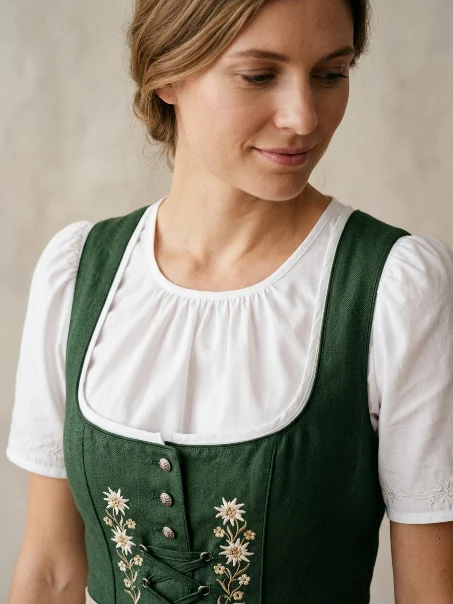
The difference between a dirndl outfit that looks assembled and one that looks styled almost always comes down to one pairing: blouse to bodice. Shopping oktoberfest shirts for women in isolation grabbing whichever white blouse the listing suggests — produces the mismatches every beer tent displays: necklines gapping below bodice edges, sleeves fighting strap lines, lace registers clashing with dress registers. Matching deliberately, the way experienced wearers and Munich shop staff do, produces the seamless frame that makes even accessible-tier outfits photograph like premium ones. This guide teaches the matching craft: the neckline-to-neckline rules, the sleeve-to-strap logic, the register alignment, and the practical pairing tests that catch mismatches before purchase.
Rule One: Neckline Echoes Neckline
The foundational match is geometric: the blouse neckline should echo the bodice neckline’s shape and sit just inside its edge. Round bodice necklines pair with gathered round-neck blouses; square bodices call for square (Karree) blouses whose corners align with the bodice’s; sweetheart bodices pair with heart-neck blouses tracing the same curve. The blouse edge shows as a clean, even frame — typically one to three centimeters of visible blouse inside the bodice line.
The two failure modes are both geometric: a blouse neckline cut lower than the bodice’s disappears entirely (the “missing blouse” look), while one cut dramatically higher or in a clashing shape creates visual argument at the outfit’s focal point. When shopping online, comparing listed neckline shapes — most quality retailers name them — prevents both.
Rule Two: Sleeves Respect the Straps
The second geometry is sleeve-to-strap. Dirndl bodice straps land at a specific shoulder point, and blouse sleeves must work beside them, not under or against them. Classic puff sleeves are engineered for this gathered volume sitting just outside the strap line which is why they remain the traditional default. Wider flutter sleeves need enough shoulder room to avoid bunching under straps; Carmen off-shoulder blouses eliminate the interaction entirely by sitting below the shoulder line, which is exactly why they pair best with wider-strapped or halter-style contemporary bodices.
Long and three-quarter sleeves interact less with straps and more with the outfit’s register — cool-weather practicality and formal polish — making them pairing-safe across most bodice styles.
Rule Three: Register Matches Register
Beyond geometry sits register: the formality and era language of blouse and dress must agree. A festival-cotton dirndl in bright gingham pairs with a simple gathered cotton blouse adding elaborate tulle lace to it reads overdressed in the wrong direction. A formal jacquard dirndl demands lace or fine-detailed blouse work a plain jersey blouse under it reads underdressed. Vintage-register dresses (muted florals, longer hems) call for heritage blouse details: eyelet lace, high necks, delicate trims. Contemporary fashion dirndl welcome Carmen necklines and minimal sleeves.
The quick test: describe dress and blouse each in one word — festival, formal, vintage, contemporary. Matching words, matching outfit.
The Matching Craft Within German Attire
This pairing discipline is not fussiness invented by retailers it is how german attire has always worked. Traditional German and Alpine dress operated as coordinated ensembles where each garment answered the others: blouse frames echoing bodice lines, apron tones answering skirt colors, jewelry scaled to neckline shapes. Regional Tracht codified these correspondences precisely because coherent ensembles signaled care, status, and belonging — an outfit that “agreed with itself” marked a wearer who knew the tradition.
The modern payoff of that heritage is a reliable aesthetic shortcut: when every piece answers the others, outfits photograph as intentional at any price tier. The pairing rules in this guide are simply that heritage, written down.
Practical Pairing Tests Before You Buy
Three checks catch mismatches at the listing stage. The shape check: does the retailer name the blouse neckline, and does it match your bodice’s shape? The measurement check: blouse sized by bust against its own chart, since a size-mismatched blouse breaks even a correct shape pairing. The register check: one-word register of dress and blouse, compared honestly.
And one physical test at first try-on: fasten the bodice fully and look for the frame — an even one-to-three-centimeter blouse edge inside the neckline, sleeves clear of straps, no bunching through the bodice body. Pass that inspection and the pairing will hold through every photograph of the season.
Building Pairs, Not Pieces
The efficient wardrobe consequence: buy blouses as deliberate pairs to specific dresses, then let overlap emerge. A gathered round-neck cotton blouse pairs with most round-neck festival dirndl — the universal workhorse. A square or heart lace blouse pairs to the formal dress that occasioned it. A Carmen pairs to the contemporary piece. Two to three blouses at $25 to $60 each, matched by the rules, cover a full multi-dress wardrobe — and every combination they create photographs like it was styled by someone who knew exactly what they were doing. Because now, it was.
Frequently Asked Questions
What’s the single most important blouse-to-dress match?
Neckline shape: the blouse echoes the bodice neckline and shows as a clean one-to-three-centimeter frame inside its edge.
Why do puff sleeves dominate traditional pairings?
Their gathered volume is engineered to sit beside bodice straps without bunching — geometry, not just style.
When is a Carmen off-shoulder blouse the right pairing?
With contemporary bodices — wider straps or halter styles — where the below-shoulder line avoids strap interaction entirely.
How do I match register between blouse and dress?
One-word test: festival, formal, vintage, or contemporary for each piece. Matching words make a matched outfit.
Can one blouse pair with multiple dresses?
Yes — the gathered round-neck cotton classic pairs with most round-neck festival dirndl, which is why it anchors every rotation.
What should matched-quality blouses cost in 2026?
Roughly $25 to $60 each; a matched two-to-three-blouse rotation covers a full wardrobe.