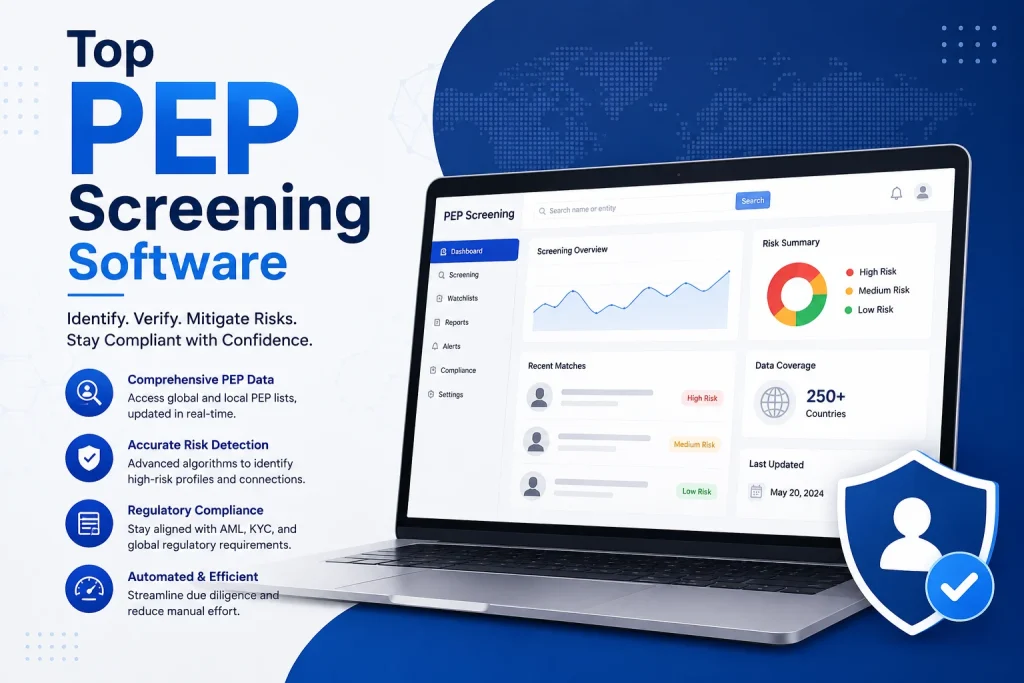
Searching for the best PEP screening software often leads to the same challenges. Every vendor claims to offer global coverage, real-time data, and a low false-positive rate. While these claims sound similar, the underlying tools change significantly. The key differences lie in three areas: the depth of coverage, the speed of data updates, and the amount of irrelevant information analysts encounter daily. This guide analyzes what truly differentiates the leading options available today, ensuring that your comparisons are based on importance rather than marketing hype. This way, your shortlist will include tools that perform effectively in real-world scenarios.
What Makes a PEP Screening Tool Top Tier?
A politically exposed person database is only useful if it reflects reality. Reality includes far more than presidents and senators. FATF guidance recognizes four PEP levels, running from heads of state down to local officials and city councilors. Most enforcement problems stem from gaps at lower levels, not the top.
Coverage Depth Separates the Field Quickly
Level 1 and Level 2 figures play a crucial role and are found in nearly all commercial databases, underscoring their importance in data analysis and decision-making. Level 4 officials are where products diverge sharply. Some providers, like AML Watcher, cover all four FATF levels systematically across 235-plus countries and territories. Others capture local officials only when they happen to make international news. That difference matters most for institutions with regionally diverse customers.
Relatives and Close Associates Need Explicit Links
A minister can rarely hold risky assets in their own name. Their spouse, sibling, or business partner often does instead. Strong tools map these RCA relationships directly, linking each associate back to the official they connect to. The best PEP screening software does not associate loose name entries with no context attached. An analyst reviewing an unlinked match has almost nothing to work with.
How do the Leading Options Compare?
The market consists of various groups, each with strengths and growth potential. Here are key considerations when comparing two options:
Enterprise Data Giants
Compliance anchors the enterprise by maintaining extensive PEP datasets utilized by major global banks. Their strength lies in their breadth and the institutional trust they have built over decades. However, their tradeoff often involves higher costs and slower, more cumbersome implementation cycles.
Established Watchlist Specialists
LSEG’s World-Check remains one of the most widely licensed PEP and sanctions datasets anywhere. Many other screening platforms actually license World-Check data and present it through their own interfaces. Institutions choosing it get proven data depth, though the matching layer on top varies by reseller.
Newer API-First Challengers
Integration is made efficient and can be accomplished in just a matter of days, rather than the lengthy months typically required. AML Watcher is at the forefront of this innovative approach, offering robust four-level coverage for Politically Exposed Persons (PEPs) alongside real-time data updates that ensure accuracy and timeliness. A key component of this solution, the TruRisk agent, proactively addresses the issue of false positives, achieving a remarkable reduction of 44%. This significant improvement not only enhances the accuracy of compliance assessments but also allows smaller compliance teams to reclaim valuable hours each week. By minimizing unnecessary distractions, these teams can better focus on their core responsibilities, ultimately improving their overall effectiveness and productivity in compliance management.
Update Speed Deserves More Scrutiny Than It Gets
Political status changes overnight. An election, a cabinet reshuffle, or an instant resignation can reclassify someone. A database refreshed monthly leaves institutions screening against stale records for weeks at a time. That exposure belongs to the institution, never the vendor.
Tips to Choose Vendors Efficiently
Ask each provider how quickly this week’s cabinet appointment would appear in their data. Vendors running genuine real-time pipelines answer with specifics. Vendors on batch update cycles get noticeably vague at this exact point. The hesitation itself is useful information.
False Positives Decide the Daily Experience
Whatever tool gets chosen, analysts live with its matching logic every single day. Name-only matching flags every common name in a customer base. Industry false-positive rates have historically run near 90 percent, burying small teams completely.
Evaluation Criteria That Matter Most
Run a pilot against a sample of real customer names, never the vendor’s demo set. Demo data is curated to perform well. Count the alerts generated, then count how many actually deserved review. Tools that use secondary identifiers, such as date of birth and nationality, consistently produce cleaner results in this test. A vendor confident in their matching logic will welcome this exercise rather than resist it.
Finding the Right Fit for Your Institution
The right transaction monitoring software depends on your institution’s size, risk exposure, regulatory obligations, and operational workflow. A global bank operating across multiple jurisdictions may justify the cost and complexity of an enterprise platform. A growing fintech often benefits more from an API-first solution that integrates quickly and scales with the business. Meanwhile, a mid-sized institution struggling with excessive false positives should prioritize detection accuracy and alert quality over the number of available features.
The best solution is the one that meets your operational needs without creating unnecessary complexity. It should provide reliable coverage, adapt to changing risk patterns, deliver accurate alerts, and integrate smoothly into your compliance workflow. Evaluating software against these practical requirements helps narrow the shortlist to solutions that genuinely support your institution’s AML program.
If you are looking for a platform that combines AI-driven detection, real-time monitoring, and configurable risk rules, AML Watcher offers transaction monitoring capabilities designed to help compliance teams identify suspicious activity more efficiently while reducing unnecessary alerts.