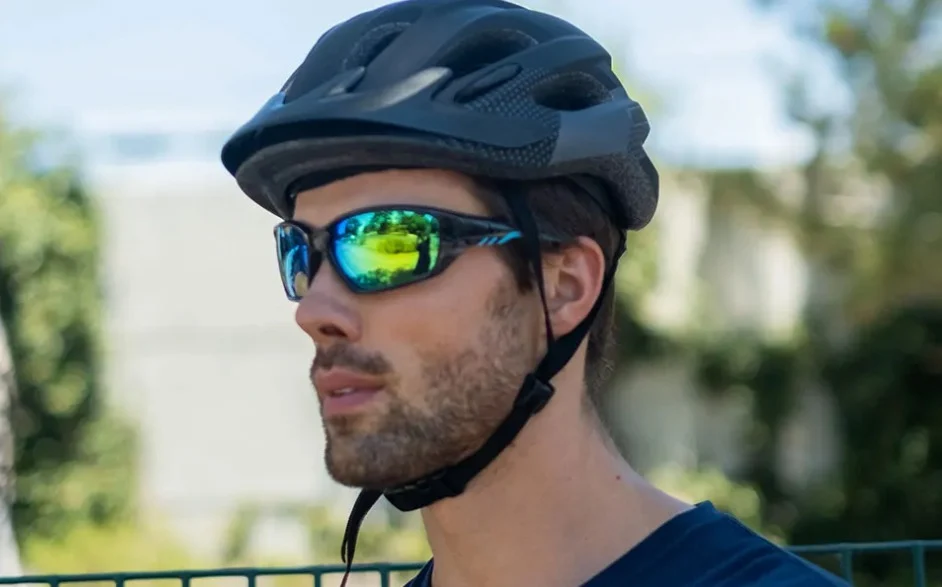
Most athletes pay attention to lens colour, UV protection, and impact resistance, but the shape of the lens itself can have a major influence on visual performance. The curvature of sports glasses affects peripheral vision, depth perception, distortion control, and the way corrective prescriptions behave during movement. Understanding lens curvature helps athletes choose eyewear that performs consistently during competition rather than simply looking sporty.
In many sports, visual decisions happen in fractions of a second. Tracking a fast-moving ball, judging distance, reacting to opponents, or navigating uneven terrain all depend on stable and accurate vision. Lens curvature plays a larger role in those tasks than most people realise.
Why Sports Glasses Use Curved Lenses
Unlike everyday eyewear, sports frames are often designed with wraparound lenses that curve around the face. This design is not only about appearance. Curved lenses increase coverage, improve side protection, and expand the effective field of view.
A flatter lens provides a narrower visual envelope, while a more curved lens allows athletes to see more of their surroundings without turning the head as much. This can be especially useful in cycling, baseball, racquet sports, and field sports where peripheral awareness is constantly being used.
However, increased curvature also creates optical challenges. The more a lens curves, the more carefully it must be engineered to maintain accurate vision across the entire lens surface.
Understanding Lens Curvature
Lens curvature refers to the degree to which a lens bends across its horizontal and vertical surfaces. Sports eyewear commonly uses a base curve measurement, which indicates how much the front surface of the lens curves.
| Lens type | Typical effect |
| Flatter lenses | Less peripheral coverage, easier prescription correction |
| Moderately curved lenses | Balanced coverage and optical stability |
| Highly curved wrap lenses | Maximum coverage and protection, but require advanced optical compensation |
The challenge is not the curvature itself. The challenge is maintaining accurate vision through that curved surface.
Why Distortion Becomes a Concern
When light passes through a curved lens, it enters at different angles across the surface. Without proper optical correction, this can create distortion, magnification changes, and peripheral blur.
Athletes may notice that objects near the edge of the lens appear stretched, compressed, or slightly displaced. During fast movement, these distortions can affect tracking accuracy and reaction time.
High-quality sports eyewear compensates for these optical effects during lens design and manufacturing.
Peripheral Vision and Situational Awareness
One of the greatest advantages of curved sports glasses is improved peripheral vision. Because the lens wraps around the face, there are fewer gaps between the frame and the surrounding environment.
This wider visual field helps athletes:
- Detect opponents approaching from the side
- Monitor teammates without turning the head fully
- Track balls and projectiles across a broader area
- Navigate crowded playing environments
- Maintain better spatial awareness during movement
For sports that require constant scanning of the environment, peripheral coverage can become a genuine performance advantage.
How Curvature Affects Prescription Lenses
Prescription lenses become more complex when they are placed into curved sports frames. A standard prescription calculated for a relatively flat lens may not perform the same way in a highly curved wraparound design.
Optical Centre Alignment
Every prescription lens has an optical centre that should align precisely with the wearer’s pupils. Curved frames change the angle at which the lens sits in front of the eyes.
If this is not properly compensated, athletes may experience:
- Peripheral distortion
- Reduced clarity toward the lens edges
- Difficulty adapting to the eyewear
- Eye strain during extended use
- Changes in perceived distance
This is one reason purpose-built prescription sports goggles often provide better visual performance than standard prescription lenses fitted into heavily curved sports frames.
The Role of Compensated Lens Design
Advanced sports prescriptions take frame wrap angle, pantoscopic tilt, and vertex distance into account during lens calculation. These measurements allow the prescription to be adjusted specifically for the curved frame.
The result is more consistent clarity across the entire lens surface, including the peripheral areas that athletes rely on during play. Specialist eyewear providers such as CA Glasses focus on these sports-specific optical considerations, where frame geometry and lens compensation are designed to work together rather than independently.
Depth Perception and Curved Lenses
Depth perception depends on accurate binocular vision, meaning both eyes must receive stable and properly aligned visual information. Lens curvature can influence how distances are perceived, particularly when looking through the outer portions of the lens.
Athletes involved in baseball, basketball, tennis, pickleball, cricket, and similar sports are especially sensitive to changes in distance judgment because they must predict the movement of fast objects in three-dimensional space.
Well-designed curved lenses preserve binocular alignment while still providing the wide field of view that athletic performance demands. The relationship between lens design and visual accuracy is explored further in how prescription sports glasses improve depth perception during play.
Choosing the Right Curvature for Different Sports
Different sports place different demands on vision, which means the ideal lens curvature is not identical for every athlete.
Cycling and Outdoor Endurance Sports
Cyclists often benefit from higher wraparound curvature because of wind protection, peripheral awareness, and environmental exposure.
Racquet and Ball Sports
Moderate curvature frequently provides a good balance between wide coverage and minimal optical distortion.
Contact and Indoor Sports
Athletes who require secure retention and impact protection often prefer prescription sports goggles, where frame stability and lens positioning remain consistent during rapid movement.
Signs That Lens Curvature Is Not Working for You
Athletes sometimes blame their prescription when the real problem is inappropriate lens curvature or poor optical compensation.
Warning signs include:
- Feeling disoriented while moving
- Peripheral blur that does not improve with wear
- Difficulty tracking fast objects
- Headaches during or after sports
- Needing extra time to adjust when putting the glasses on
- A sensation that distances look slightly altered
These symptoms are often worth discussing with an eyewear provider experienced in sports-specific lens design.
A Practical Way to Evaluate Curved Sports Eyewear
When testing athletic eyewear, avoid judging it only while standing still. Move through motions similar to the sport you actually play.
A useful evaluation includes:
- Looking left and right rapidly
- Tracking a moving object
- Looking upward and downward repeatedly
- Jogging or moving laterally
- Wearing the glasses for at least 15 minutes
- Checking whether edge vision remains clear and comfortable
This dynamic testing reveals problems that may not appear during a brief fitting.
The Connection Between Curvature and Athletic Performance
Visual performance is not determined by prescription accuracy alone. Frame stability, lens position, peripheral coverage, and optical distortion all influence how efficiently the brain processes visual information during sport.
A properly designed curved lens allows athletes to maintain awareness of their surroundings while preserving accurate depth perception and edge-to-edge clarity. This becomes especially important in competitive environments where reaction time is measured in fractions of a second.
Understanding lens curvature helps explain why sports glasses designed specifically for athletic use perform differently from standard everyday eyewear. The right combination of curvature, prescription compensation, and frame design can improve peripheral awareness, reduce distortion, and provide the consistent vision that athletes rely on during demanding physical activity.