While 100G CoF offers superior determinism for point-to-point applications, the industry has not ignored the potential of Ethernet for high-speed imaging. The introduction of GigE Vision 3.0, with its support for RDMA (Remote Direct Memory Access) over RoCEv2 and Time-Sensitive Networking (TSN), has significantly enhanced the capabilities of Ethernet-based imaging systems. These innovations address the traditional limitations of Ethernet—specifically, the latency variability and CPU overhead that previously made it unsuitable for demanding real-time applications. For system integrators considering high-throughput cameras for large-scale distributed inspection, GigE Vision 3.0 offers a compelling combination of performance and scalability.
Understanding the Traditional Limitations of Ethernet for Imaging
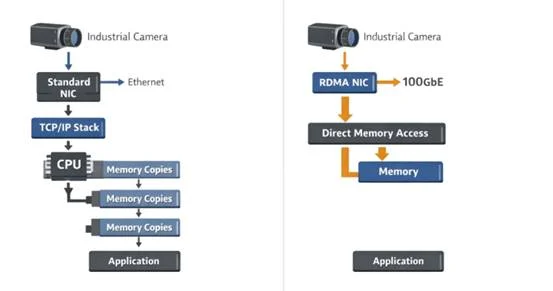
Traditional Ethernet-based imaging systems relied on the TCP/IP protocol stack for data transmission. While TCP/IP is robust and widely supported, it introduces several overheads that are problematic for high-speed imaging. First, the protocol stack requires multiple memory copy operations as data moves from the network interface card to application memory. These copies consume CPU cycles and increase latency. Second, TCP/IP’s flow control and retransmission mechanisms can introduce variable delays, making it difficult to achieve deterministic timing. Third, the CPU must handle interrupt processing for each incoming packet, which can become a bottleneck at high data rates.
For a high speed camera generating data at 100Gbps, these limitations quickly become apparent. The CPU may be unable to keep up with the interrupt rate, resulting in dropped packets or increased latency. The variable delay introduced by the TCP/IP stack can disrupt synchronization with other system components. And the memory copy overhead can significantly reduce the throughput of the host system, limiting the ability to perform real-time image analysis.
RDMA over RoCEv2 – Bypassing the TCP/IP Bottleneck
GigE Vision 3.0 addresses these limitations through the introduction of RDMA over RoCEv2. RDMA allows data to be transferred directly from the network interface card to application memory, bypassing the TCP/IP stack entirely. This eliminates multiple memory copy operations and reduces CPU involvement in the data transfer process. The result is lower latency, higher throughput, and significantly reduced CPU overhead.
For a high-throughput camera, this innovation is transformative. Instead of consuming CPU cycles on interrupt handling and data copying, the host system can dedicate its processing power to image analysis and defect detection. The reduction in latency also improves the responsiveness of the system, making it suitable for applications where real-time feedback is required.
TSN – Enhancing Determinism in Switched Networks
While RDMA addresses the CPU overhead and latency of individual data transfers, it does not fully solve the determinism challenge in switched networks. This is where Time-Sensitive Networking (TSN) comes in. TSN is a set of standards that enable deterministic communication over Ethernet by providing precise timing and synchronization for networked devices.
TSN introduces several key features that benefit imaging applications. First, it provides precise time synchronization across all devices on the network, enabling coordinated timing for multi-camera systems. Second, it supports scheduled traffic, where time-critical data such as camera triggers and synchronization signals are prioritized over other network traffic. Third, it provides bounded latency, ensuring that data packets arrive within a predictable time window.
For a high speed camera deployed in a switched network, TSN ensures that critical data—such as synchronization signals or urgent inspection results—arrives at the destination with minimal and predictable delay. This makes Ethernet-based imaging systems more suitable for real-time applications that previously required dedicated interfaces.
Summary: Key Innovations in GigE Vision 3.0
| Innovation | Description | Benefit for High-Speed Imaging |
| RDMA over RoCEv2 | Direct data transfer from NIC to application memory | Low latency, reduced CPU overhead, high throughput |
| Time-Sensitive Networking (TSN) | Deterministic communication with precise timing | Bounded latency, coordinated multi-camera synchronization |
| Zero-copy data transfer | Eliminates intermediate memory copies | Improved efficiency at high data rates |
Why GigE Vision 3.0 Matters for Future Systems
The advancements in GigE Vision 3.0 have significant implications for the future of high-speed imaging. First, they make Ethernet a viable option for applications that previously required dedicated interfaces. This opens up new possibilities for system architecture, particularly in large-scale distributed inspection systems where Ethernet’s scalability is a major advantage.
Second, they enable tighter integration with AI and edge computing platforms. With RDMA, data can be transferred directly from the camera to GPU memory, enabling real-time AI inference without the latency and CPU overhead of traditional data paths. This is critical for applications such as automated defect classification, where decisions must be made in milliseconds.
Third, they support the evolution toward more flexible and software-defined imaging systems. With Ethernet, cameras can be easily added, moved, or reconfigured, providing the agility that modern manufacturing environments require. Companies like Tucsen are investing in this technology pathway, ensuring that their high-throughput camera solutions are ready for the next generation of Ethernet-based inspection systems.
Choosing Between CoF and GigE for High-Speed Imaging
The choice between 100G CoF and 100 GigE ultimately depends on the application requirements. For point-to-point systems where determinism is critical, 100G CoF remains the preferred choice. Its hardware-level synchronization and predictable latency make it ideal for semiconductor inspection and other demanding applications. For large-scale distributed systems where scalability and network integration are paramount, GigE Vision 3.0 offers compelling advantages. As TSN continues to mature, Ethernet-based solutions will become increasingly capable of meeting the determinism requirements of real-time inspection.
Conclusion
GigE Vision 3.0, with its support for RDMA over RoCEv2 and TSN, represents a significant step forward for Ethernet-based imaging systems. By addressing the traditional limitations of latency, CPU overhead, and determinism, it enables a high-throughput camera to operate effectively in environments that previously required dedicated interfaces. For system integrators seeking scalable, network-integrated solutions for large-scale inspection, GigE Vision 3.0 offers a path forward that combines the flexibility of Ethernet with the performance demanded by modern high-speed imaging applications. As companies like Tucsen continue to develop products that leverage these innovations, the line between dedicated and networked imaging solutions will continue to blur, offering system designers more options than ever before.