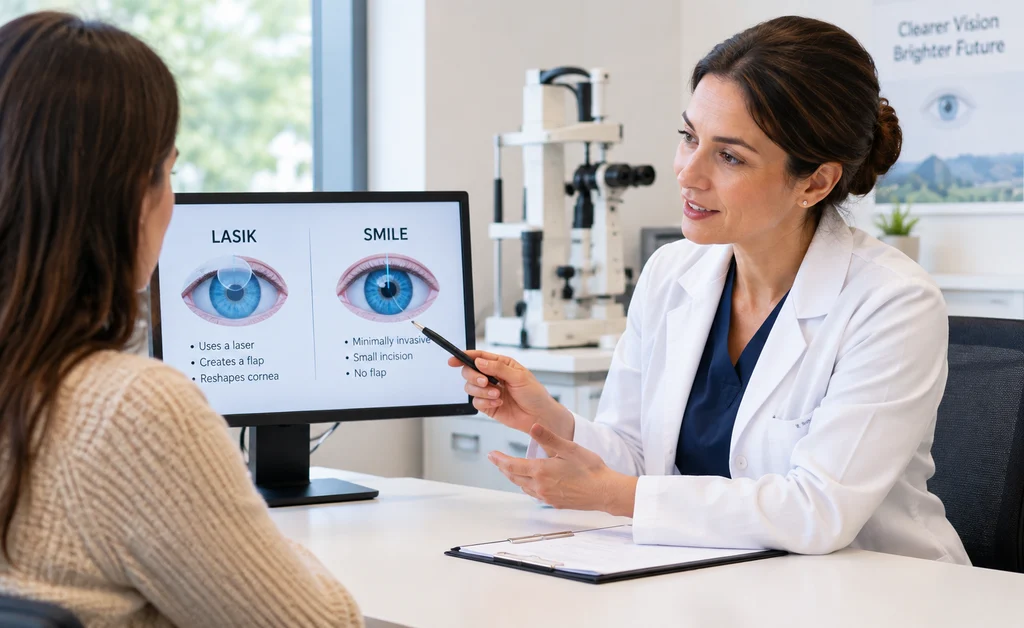
Both LASIK and SMILE can free you from glasses and contacts. But they aren’t the same procedure, and they aren’t interchangeable. Which one fits you depends on your corneal anatomy, your lifestyle, and what you care about most during recovery. Here’s what’s worth thinking through before you book a consultation!
Who Is an Ideal LASIK Candidate?
LASIK has been around for more than 30 years. That makes it one of the most studied elective procedures in medicine, and that long history is a big part of why people trust it. By now, the ideal patient profile is well understood.
Good candidates usually have a stable prescription – one that hasn’t shifted much over the past year or two. Surgeons also want to see healthy corneas with enough thickness to work with. That’s because LASIK involves cutting a thin flap in the outer layer of the cornea, then reshaping the tissue underneath. If your corneas are very thin, or your prescription is extremely high, there may not be enough tissue to do this safely.
Age plays a role too. Most surgeons suggest waiting until you’re at least 18, and ideally until your vision settles in your early-to-mid 20s.
Then there’s the lifestyle angle. LASIK is a great match if you want to get back to normal fast. Most people see a big improvement within 24 hours, and plenty are back at work the next day. If your schedule can’t accommodate a long recovery, that’s a real point in its favor.
Who Tends to Do Well with SMILE?
Most LASIK vs SMILE eye surgery comparisons come back to one structural difference: SMILE skips the corneal flap entirely. Instead, a laser shapes a small lens-shaped bit of tissue – called a lenticule – inside the cornea, and the surgeon removes it through a tiny incision. Less disruption to the surface, more of your cornea left intact.
Right now, SMILE is FDA-approved for myopia (nearsightedness) and astigmatism. If you have healthy corneas and fall within those correction ranges, you’re likely a solid candidate.
There’s another benefit worth knowing. Because SMILE disturbs the corneal nerves less than LASIK does, it tends to bring a lower risk of post-surgical dry eye. That matters a lot if you already deal with dryness or wear contacts heavily. Athletes and anyone in contact sports often lean toward SMILE, too – with no flap, there’s no chance of a flap getting knocked loose by a stray elbow.
The catch? SMILE is newer, so the long-term evidence base is shorter. It usually costs more than LASIK, and it isn’t available in as many places across the US.
How Do the Two Procedures Compare on Key Factors?
Corneal requirements
Both need adequate corneal thickness, but SMILE’s flapless approach tends to preserve more tissue. So if your corneas are borderline and LASIK is off the table, SMILE might still be an option. It really depends on your individual anatomy.
Recovery and visual stability
LASIK usually gives you faster visual recovery up front. With SMILE, vision can take a little longer to stabilize over the first few weeks – but the final results end up comparable.
Dry eye risk
The research is pretty consistent here: SMILE produces fewer dry eye symptoms afterward. If you’re already prone to dryness, that difference can shape your comfort for years.
Cost and access
LASIK is more widely available and often cheaper. SMILE’s higher price reflects its newer technology, and don’t count on vision insurance or an FSA to cover it – they rarely cover LASIK either.
The Best Procedure Is the One That Fits Your Eyes
Neither procedure wins outright. LASIK’s track record and quick recovery make it the default for many people, and rightly so. SMILE is a strong alternative if corneal preservation and dry eye reduction are your priorities – especially for athletes or anyone already fighting dryness.
The step that matters most is a thorough pre-operative evaluation. A qualified refractive surgeon can weigh your corneal measurements, prescription, and lifestyle, then point you toward the right fit.