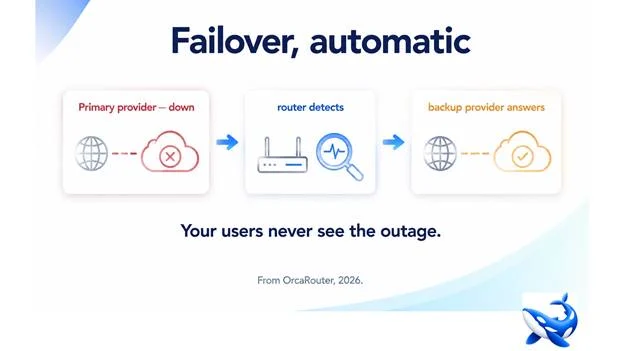
When the model vendor your application depends on has an outage, what happens to your users? Without a router, the answer is usually an error screen or a long retry loop. With an AI router, the answer is nothing — the request quietly goes to a healthy alternative. OrcaRouter is one platform built around this pattern; here is how failover works and why it is the availability story your product actually needs.
What failover means, concretely
You configure more than one model in the pool — not just for quality, but as deliberate redundancy. The primary is your default: the model you want for most requests. The backup is a healthy alternative from a different provider, so that a single vendor’s incident does not take down your whole stack.
When the primary fails — an outage, a rate limit, a 5xx storm — the router detects it and sends the request to the next healthy option. The request completes, at the backup model’s price and quality, and your users never see the failure.
Why this matters more than you think
A single-provider dependency is a single point of failure. The vendor’s availability becomes your availability, and their incident becomes your incident. Teams discover this during the outage that actually costs them, which is exactly when it is too late to add redundancy.
Failover moves the risk to the router, which can see the whole picture: it knows which providers are healthy right now, which are degraded, and which are rate-limiting. It can fail over before a request even fails, or after one failed attempt — either way, the user gets an answer.
The operational difference
• No retry loop. Without a router, an app retries the same dead provider, burning budget and latency on a failure it knows nothing about. The router knows and moves on.
• No error surface. The failure never reaches the user. That is the whole point: availability is a product feature, and failover is how a router delivers it.
• No single-vendor dependence. A price hike, a deprecation, an outage — any one of them stops being an emergency when the router can route around it.
The configuration that makes it real
Failover is only as good as the pool you configure. A backup model from the same vendor as your primary is not failover — it is the same incident with a different endpoint. The redundancy is real only when the fallback comes from a different provider, so that a vendor-wide outage leaves you with somewhere to go. The router lets you define the order and the health thresholds: fail over after one error, or pre-emptively when the primary starts degrading. Most teams start with the simple version — primary, backup, fail on error — and add health-based pre-emption once they see how often providers degrade before they fail. The important thing is that the mechanism exists and is tested before the outage, because testing failover during an incident is how incidents get worse.
The part of failover nobody tests
Every team believes their failover works until the first real outage, which is exactly when misconfiguration is most expensive. The discipline that separates good setups from bad ones is testing the failure path: kill the primary in staging — a bad key, a forced rate limit, a simulated outage — and confirm the router routes around it. This takes an hour and it finds the wrong model string, the missing fallback, the alert that never fires. Failover is a feature, and like any feature it deserves a test before it needs to work for real.
The cost of not having it
The cost of no failover is easy to underestimate until it happens: the vendor outage you discover from your own monitoring, the users who hit an error page, the on-call engineer who spends the night retrying a dead endpoint. Add the revenue and trust impact and the cost is usually far above the price of the router that would have routed around it. Failover is one of those purchases that looks optional until the day it is the whole difference. That is why it belongs in the first configuration you do, not a later enhancement — and why testing it in staging is part of the setup, not a nice-to-have.
The takeaway
A vendor outage stops being your outage when an AI router can fail over to a healthy alternative automatically. You configure a primary and a backup from different providers; the router detects the failure, routes around it, and your users never see the error. That is the difference between depending on one vendor’s availability and having your own. For production LLM work, failover is not a nice-to-have — it is the availability story.
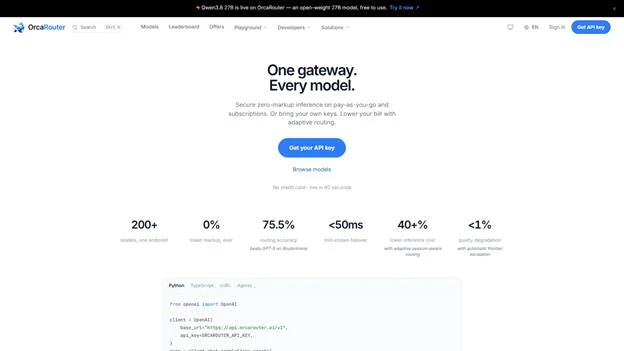
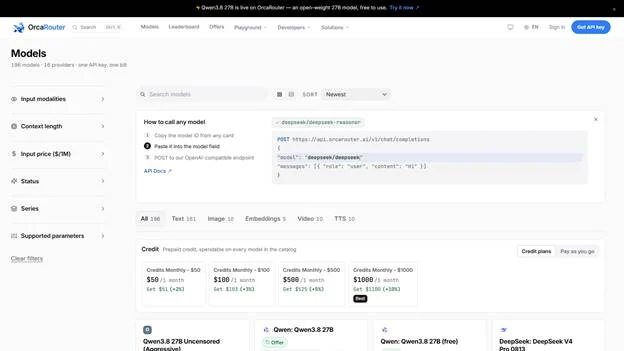
Sourcing note: this article describes the AI-router category and OrcaRouter’s implementation. Automatic failover and provider-health awareness are OrcaRouter’s own published descriptions, checked August 2026.