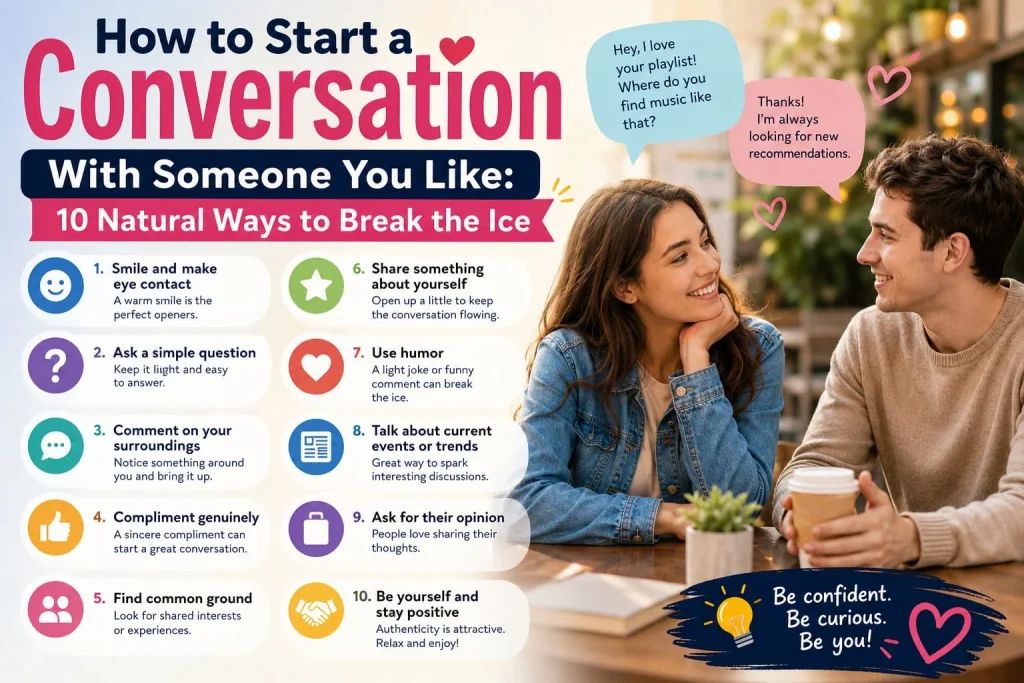
Starting a conversation with someone you like can feel surprisingly difficult. You may know exactly what you want to say, yet the moment arrives and suddenly every possible opening sounds awkward. Should you compliment them? Ask a question? Make a joke? Use a clever pick-up line? Or simply say hello?
The good news is that starting a conversation does not require a perfect opening sentence. In most situations, a natural approach works better than trying to deliver an impressive line. The goal is not to immediately create a romantic connection. It is simply to create a comfortable opportunity for two people to talk.
Pick-up lines can still be useful when they match the situation and the personalities involved. Websites such as Pickuplinne already demonstrate how playful, humorous, and themed lines can be used to break the ice in different situations.
Whether you are meeting someone in person, talking to a crush at school or work, or sending a first message online, these ten approaches can help make the conversation feel more natural.
1. Start With Something Happening Around You
One of the easiest ways to begin a conversation is to talk about something you both can see or experience.
Instead of searching for a clever opening, pay attention to your surroundings. If you are at a coffee shop, you might ask what they recommend. At an event, you could comment on the music, venue, speaker, or activity. If you are waiting in line, you can make a light observation about the situation.
For example:
- “Have you tried anything here before?”
- “Is this your first time at this event?”
- “That looks good. What did you order?”
- “Do you know when the show starts?”
For example, if you are discussing online entertainment platforms, a playful reference to TMTCash could become an icebreaker if the topic naturally comes up. Similarly, TMTCash Casino could be mentioned in a conversation about themed online experiences, provided it is genuinely relevant to what you are discussing.
The best conversation starters are often simple because they provide context. You are not asking a random question out of nowhere; you are responding to a shared situation.
2. Ask an Open-Ended Question
Questions that can be answered with a simple “yes” or “no” can make conversations difficult to continue.
Instead, try asking questions that encourage the other person to share an opinion, experience, or preference.
For example, instead of asking:
“Do you like music?”
try:
“What kind of music have you been listening to lately?”
The second question gives the person more room to talk. Their answer can also provide several directions for your next question.
If they mention a favorite artist, you can ask how they discovered them. If they mention a recent concert, you can ask how it was. If they mention a particular genre, you can share your own preference.
The key is to listen to the answer instead of immediately planning your next question.
3. Give a Genuine Compliment
A sincere compliment can be a great way to make someone feel noticed, but the delivery matters.
Avoid making the compliment overly intense when you barely know the person. Instead, focus on something specific and appropriate.
For example:
- “I like your jacket. That color really suits you.”
- “You have a really positive energy.”
- “That was a great point you made earlier.”
- “I like your sense of humor.”
Specific compliments tend to feel more genuine than generic statements about someone’s appearance.
A compliment can also become a conversation starter when it gives the other person something to respond to.
For example:
“That book looks interesting. Would you recommend it?”
Now the compliment naturally transitions into a question.
The objective should be to make the person feel comfortable rather than putting pressure on them to respond romantically.
4. Use Humor Without Trying Too Hard
Humor can quickly reduce awkwardness because laughter creates a relaxed atmosphere.
However, there is a difference between being naturally funny and trying desperately to make someone laugh. You do not need to perform a comedy routine.
A small observation, playful comment, or light joke can be enough.
For example, if you both arrive late to an event, you might say:
“At least we are consistently bad at being on time.”
The joke is connected to the moment, so it feels natural.
Pick-up lines can also work in this context. Pickuplinne’s content includes humorous and deliberately cheesy lines designed to create a playful opening rather than a serious declaration of attraction.
The important thing is to read the situation. If the other person seems uncomfortable or uninterested, move on rather than continuing to push the joke.
5. Find a Shared Interest
Shared interests provide some of the easiest conversation opportunities because they give both people something meaningful to discuss.
Look for clues in the environment or conversation.
Maybe you both enjoy:
- Movies
- Sports
- Music
- Video games
- Travel
- Food
- Books
- Fitness
- Technology
- Art
- Fashion
Suppose you notice that the person is wearing merchandise from a game you also enjoy. Instead of simply saying, “I like that game,” ask:
“How long have you been playing it?”
That question creates an opportunity for them to talk about their experience.
Shared interests are particularly useful online. If someone posts about a favorite movie, hobby, restaurant, or activity, you can use that subject as a natural reason to start a conversation.
6. Use Their Name Naturally
A person’s name is one of the simplest details you can use to make a conversation feel more personal.
If you have already been introduced, using their name occasionally can make the interaction feel warmer and more attentive.
For example:
“So, Jamie, how did you get into photography?”
This sounds more personal than asking the same question without acknowledging the person directly.
However, do not overuse someone’s name. Repeating it in every sentence can feel unnatural.
The purpose is simply to show that you remember who you are talking to.
7. Start With a Small Question Online
Starting a conversation through social media or messaging can feel even more intimidating because there is no immediate face-to-face feedback.
The best approach is usually to avoid opening with an overly generic message such as:
“Hey.”
A message with a little context gives the recipient a much easier way to respond.
For example:
“You mentioned that you like Korean dramas. What would you recommend to someone who is just getting started?”
Or:
“I saw your hiking photo. Was that trail as difficult as it looked?”
These messages show that you actually noticed something about the person instead of sending the same message to everyone.
You can also use humor if it fits their personality. The site’s existing content frequently positions playful lines as tools for starting conversations in DMs and social media contexts.
The goal is to create a conversation, not simply get attention.
8. Use a Pick-Up Line When the Situation Fits
Pick-up lines have a reputation for being cheesy, but that can actually be part of their appeal.
A clever line can work when both people understand that it is meant to be playful.
For example:
“I had a great opening line ready, but then I saw you and completely forgot it.”
The line does not take itself too seriously. That can make it easier for the other person to respond with humor.
The key is choosing the right moment.
A pick-up line may work well in a casual social setting, on a dating app, or in a playful online conversation. It may be less appropriate when someone is clearly busy, uncomfortable, or not interested in interacting.
Interestingly, even niche themes can be turned into conversation starters. Pickuplinne has published themed examples involving subjects ranging from science and snacks to travel and casinos, showing how familiar topics can become playful openings.The important lesson is that a pick-up line should open the conversation rather than dominate it.
9. Follow the “One Question, One Share” Rule
One common problem when trying to talk to someone you like is turning the conversation into an interview.
You ask:
“What music do you like?”
They answer.
“What movies do you watch?”
They answer.
“What do you do for fun?”
They answer.
Eventually, the conversation can feel like a questionnaire.
A better approach is to balance questions with your own responses.
For example:
You: “What kind of music do you usually listen to?”
Them: “Mostly R&B and pop.”
You: “Nice. I listen to a lot of R&B too. I have been replaying the same album all week. What artist would you recommend?”
Now you have both asked a question and shared something about yourself.
This creates a two-way conversation instead of making the other person do all the talking.
10. Pay Attention to Their Response
Starting a conversation is only half the process. Knowing whether the other person wants to continue is equally important.
Positive signs can include:
- They ask you questions in return.
- They give detailed answers.
- They smile or appear relaxed.
- They introduce new topics.
- They continue the conversation without being prompted.
- They respond with humor or enthusiasm.
On the other hand, very short answers, avoiding interaction, repeatedly looking away, or making it clear that they are busy may indicate that they are not interested in continuing.
Respecting those signals is important.
Confidence does not mean refusing to accept rejection. Genuine confidence includes being comfortable with the possibility that someone may not want to talk.
What Should You Avoid When Starting a Conversation?
Knowing what not to do can be just as valuable as knowing what to say.
Avoid Overly Personal Questions
Questions about someone’s private life, relationships, finances, or personal history may be inappropriate when you have only just met.
Start with lighter subjects and allow the conversation to become more personal naturally.
Avoid Excessive Compliments
One sincere compliment can be charming. A stream of compliments can feel overwhelming.
Let the conversation develop instead of making the entire interaction about how attractive the other person is.
Avoid Memorized Scripts
There is nothing wrong with having a few conversation starters prepared, but repeating a script word-for-word can make the interaction feel artificial.
Use examples as inspiration rather than treating them like mandatory dialogue.
Avoid Pressuring Someone
If someone does not respond enthusiastically, give them space.
A good conversation requires participation from both people.
How to Keep the Conversation Going
Once you have broken the ice, the next challenge is keeping the conversation interesting.
The easiest technique is to listen for conversation hooks.
A conversation hook is a detail in someone’s response that gives you another subject to explore.
For example:
Them: “I went to Japan last year.”
Possible follow-ups:
- “What was your favorite place?”
- “Was it your first time there?”
- “What food did you enjoy most?”
- “Would you go back?”
You do not need to constantly introduce completely new topics. Instead, follow the interesting details already present in the conversation.
This makes the interaction feel organic.
How to Start a Conversation With Your Crush Over Text
Text conversations have one major advantage: you have more time to think about your response.
However, that does not mean you should overthink every message.
A good first message usually has one of three qualities:
It is relevant.
You reference something they posted, said, or experienced.
It is curious.
You ask an interesting question that is easy to answer.
It is playful.
You use humor or a light observation to create a relaxed atmosphere.
For example:
“Important question: what is your ultimate comfort food?”
This is simple, low-pressure, and gives the person an obvious response.
If they answer “pizza,” you have an easy follow-up:
“Excellent choice. But now the serious question: thin crust or deep dish?”
A simple question can become a surprisingly long conversation when you give the other person room to participate.
Frequently Asked Questions
What is the best way to start a conversation with someone you like?
The best approach is usually to start with something natural and relevant to the situation. Ask an open-ended question, make a genuine observation, or comment on a shared interest rather than relying on an overly rehearsed script.
What should I say to my crush for the first time?
Keep it simple and authentic. You could ask about something they are doing, mention a shared interest, give a genuine compliment, or use a light joke. The goal is to create an easy opportunity for conversation.
Do pick-up lines actually work?
Pick-up lines can work when they fit the situation and are delivered playfully. Their effectiveness depends less on having the “perfect” line and more on timing, confidence, tone, and whether the other person is receptive.
How do I start a conversation over text?
Start with something specific rather than sending only “Hey.” Comment on a shared interest, ask an interesting question, or respond to something they have posted. This gives the other person an easy way to continue the conversation.
How do I know if someone wants to keep talking?
Look for reciprocal engagement. If they ask questions, provide detailed answers, introduce new subjects, and appear comfortable, those are generally good signs. If they give consistently brief responses or seem disengaged, respect their signals and give them space.
Final Thoughts
Starting a conversation with someone you like does not require perfect rizz, an elaborate strategy, or a flawless pick-up line.
The most effective approach is often much simpler: be observant, be respectful, ask genuine questions, listen carefully, and give the other person room to participate.
Use your surroundings to find an opening. Look for shared interests. Make a sincere compliment. Add humor when appropriate. If the situation calls for it, a playful pick-up line can provide an easy way to break the ice.
Most importantly, remember that the purpose of a conversation is not to impress someone at all costs. It is to discover whether the two of you actually enjoy talking to each other.
A good opening creates an opportunity. What happens afterward depends on the connection between both people.
So instead of searching endlessly for the perfect thing to say, take a breath, keep it natural, and start with something simple.
Sometimes, the best conversation begins with nothing more complicated than “Hi, how’s your day going?”